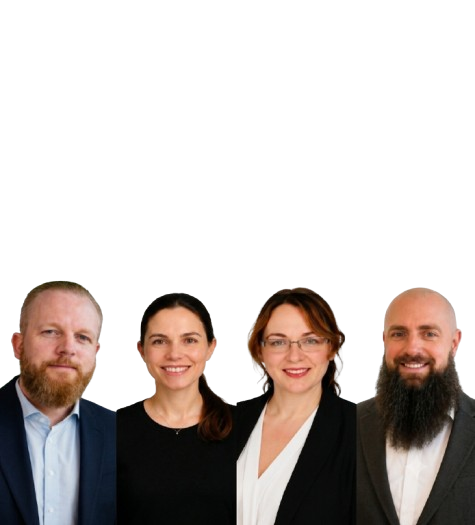
Dr Michael Schäfer is a technology expert with a PhD in Artificial Intelligence for Materials Science. He’s Head of AI & Digitalisation at SHS, founding and building the department and driving the enterprise-wide adoption of AI across the entire group.
Dr Anna Vocke studied physics in Mainz and Stony Brook. She joined SHS in late 2022 and now leads the company’s Specialised AI department, which develops and deploys tailored AI solutions in close collaboration with domain experts across the group.
Dr Ulrike Faltings studied mathematics in Bonn and Kaiserslautern. She leads the R&D group within SHS’s AI department, which focuses on more experimental AI approaches and solutions for internal projects. R&D also handles funded research projects.
Dr Tobias Bettinger has been working with AI in mechanical engineering since his research at Kaiserslautern University and RWTH Aachen University. He leads the Generative AI department, driving the group-wide adoption of generative AI and the implementation of scalable, production-ready use cases.
In our latest post, data experts from Stahl Holding Saar, the German holding company behind Saarstahl and Dillinger Steel, explain how AI is transforming one of the world’s oldest industries. Data and AI is now deployed across the entire production process at SHS, optimising performance, quality and yield. With such advancements being made, what does the future hold for AI in the heavy industry?
By Michael Schäfer
A modern steel plant is no longer simply a mechanical facility; it’s a digital ecosystem. Sensors, simulation, and automation work in combination to drive quality and efficiency. At SHS, significant investment in digitalisation, computer science, and AI runs throughout our steel and rolling mills. Equally important, though, is the human dimension: this transformation requires people with the mindset and willingness to embrace change.
Our team’s focus is AI. Specifically, industrial AI for production environments. Importantly, we started long before the recent surge of public interest in AI.
We started in 2017 with just three full-time employees and one working student, with an exclusive focus on applying AI directly to our manufacturing processes. That focused foundation has been central to everything we’ve built since.
Since those early days, we’ve grown significantly and now operate across three distinct sub-departments, totalling 20 people. Today, we serve both Saarstahl and Dillinger Steel, as well as all subsidiary companies across the group.
The team is deliberately interdisciplinary, bringing together computer scientists, mathematicians, physicists, mechanical engineers, and computational linguists. That breadth of expertise is essential and it means AI now touches almost every part of our business.
When we started, AI was far from accepted even within the Industry. The turning point came from involving business units and domain experts early on, making AI a collaborative endeavour rather than something imposed from outside. Over time, we delivered projects with tangible production impact, and that track record built credibility.
If I were to distil our approach, it would be this: start early, prioritise collaboration, and stay open to new ideas. But fundamentally, it comes down to people. That has always been the most important factor.
Each team has a distinct focus. Anna Vocke’s Specialised AI team concentrates on AI applications within steel production itself. Tobias Bettinger’s GenAI team is currently more active in administrative and business functions. Ulrike Faltings’s R&D team works across all areas of the business and leads our national and international research projects.
It’s significant. As a company with a long industrial history, we work across a broad and heterogeneous technology landscape, multiple databases, ERP and MES systems, and a large number of in-house applications.
On the sensor side alone, the range is striking: older facilities operate with around 500 sensors, while our newest continuous casting plant at Saarstahl has over 10,000. Managing that complexity is a core part of what we do.
Speed and data security are the primary reasons. Steel production is a real-time environment and there is no tolerance for latency or downtime. Depending entirely on cloud infrastructure makes it extremely difficult to guarantee continuous availability.
Running our own data centres gives us the control and reliability that production demands. Temperature control in a steel mill is a good example of this. When you need to adjust conditions on the production line, waiting even ten seconds for a result is not an option. The decision has to happen immediately.
AI has made people braver. Steel production is a deeply traditional industry and AI has given people the confidence to test new approaches and challenge established ways of working. The suggestions generated by AI models create a kind of permission to experiment, and that shift in mindset is significant.
From a technical standpoint, we can now do things that were simply not possible a decade ago: optimising complex processes, implementing hyper-automation, and replacing static physical models with dynamic, data-driven alternatives. The pace at which we can develop and deploy models has increased dramatically, and that has a real impact on how we run our operations.
AI allows us to optimise and hyper-automate processes in ways that weren’t previously feasible. More specifically, it enables us to replace slow physical models with fast, dynamic AI models. The ability to deploy models rapidly and have them operate online rather than statically is a significant competitive advantage, in steel and across industry in general.
Much like the wider department, the team is deliberately interdisciplinary. We have computer scientists, mathematicians and I’m a physicist by background myself. That diversity of perspective is central to how we work. Approaching problems from different angles, drawing on different training and intuitions, is what allows us to tackle the complexity of what we’re dealing with.
It means AI that is built specifically for our company and, more precisely, for each individual process we are working on. Our production processes are complex and highly particular so there is no viable off-the-shelf solution.
Every model we build is tailored to the data we have and the process it needs to describe. That specificity is the defining characteristic of what we do.
The full spectrum of modern data science. For computer vision applications, we work for instance with YOLO models; for structured tabular data, gradient-boosted decision trees are a frequent choice. The method always follows the problem – we assess what the challenge requires, evaluate the available approaches, and adapt the most appropriate one to our specific data and process context. Given the diversity of our project portfolio, the range of techniques in active use at any one time is equally broad.
The range is again very broad. The classic operational challenges are increasing yield and reducing downtime, which we address through predictive and optimisation models. But we also work on safety-critical applications, using computer vision, for example, to identify when individuals have entered hazardous areas and trigger immediate alerts. The variety of problems is what makes the work genuinely interesting.
It takes many forms and it’s one of our most persistent challenges. Because steel is a traditional industry, data collection was never designed around a clean, structured model. It grew incrementally, and much of it still lives in Excel spreadsheets with inconsistent formats. In databases, we encounter missing columns, data entered into the wrong fields, and unexplained legacy entries that have never been cleaned up. Missing values are pervasive. All of this creates significant friction when building AI models.
In my experience, the single hardest part of any AI project is not the modelling itself, it’s acquiring clean, reliable data to work with.
Sensor data written directly to a database is genuinely the best-case scenario. It’s structured, timely, and consistent. That said, it isn’t without its own challenges. Sensors can fail, and quality still needs to be validated. The more insidious issue is data drift. Sensors degrade over time, furnaces are relined, raw materials change, and signals that were normal six months ago gradually shift.
For AI models that were trained on historical sensor data, that slow drift can be a serious problem and requires constant attention.
It’s most painful when you have a compelling, well-reasoned concept for an AI model, one that would clearly deliver value, but the data simply isn’t there to build it.
Either it was never collected, or the quality is too low to be useful. We have techniques to work around certain data limitations, but there is a genuine ceiling. Without data, you cannot do data science. That is a frustrating reality when you have a strong idea and no way to realise it.
It can help at the margins. We do use first principles to supplement missing values when a partial data foundation exists. But replacing an entire AI model with first-principles modelling is a different matter entirely. Steel processes are extraordinarily complex. No model, for example, captures the processes and interactions inside a blast furnace in its entirety from first principles nearly impossible.
Our approach is to use first principles as a complement to data, not a replacement for it.
It starts with deep engagement with domain experts. You cannot build a reliable pipeline without understanding what normal process ranges look like, what variability is expected, and what constitutes an anomaly worth acting on. That knowledge gets built into guardrails and constraints that prevent your data from drifting silently into territory your model wasn’t trained to handle.
Beyond that, ongoing monitoring is non-negotiable. Models that perform well in training will degrade as conditions change. The discipline of continuously checking model performance against live production data and adapting when needed is what separates a robust pipeline from one that eventually fails quietly.
Two projects come to my mind here.
The first involved rethinking how we evaluate input materials. Rather than assessing them purely on purchase price, we modelled their impact across the entire production chain – from the blast furnace through the steel plant and into the final products and by-products sold to customers. A seemingly marginal difference in input material cost can translate into substantial savings when multiple across thousands of tons of daily output.
The second involved a quality issue that was putting a major customer relationship at risk. Working in close collaboration with domain experts, we traced the root cause of the defects and resolved it. The financial value of retaining that customer is difficult to quantify precisely, but the stakes were clear to everyone involved.
Those examples reflect the broader pattern well. Our AI-driven temperature models for the steel mills in Dillingen and Völklingen are another strong example as they consistently outperform the traditional physical models they replaced. Similarly, our ability to predict oxygen levels in steel has dramatically reduced the need for physical testing. Across these kinds of projects, production is where we have generated the most measurable financial impact.
Integration is the hardest problem. Every model we build has to operate within an existing IT and OT landscape that is highly heterogeneous: legacy systems, multiple vendors, and several generations of automation technology, all running simultaneously.
Getting a new AI model to integrate cleanly into that environment is frequently more demanding than building the model itself. Training on historical and real-time data is one thing; connecting it reliably to live production systems is another challenge entirely.
Our standard approach is parallel running. Before a model is given any control over the process, we deploy it alongside live operations. Its outputs are made visible to engineers and relevant stakeholders in the plant, but it isn’t acting on the process yet.
During this phase, we collect both the process data and the model’s predictions, and observe how domain experts interpret and respond to the outputs. This gives us a rigorous, real-world view of how the model would perform if fully integrated without any operational risk.
Our most reliable mechanism is the domain experts themselves. Because they work with the model outputs daily, they are quick to notice when predictions become unrealistic or when something doesn’t look right. That human awareness is our most effective early warning system.
This matters enormously because model failure in practice is rarely a clean crash or an obvious error. It tends to be subtle; a slow drift in behaviour that could easily go unnoticed without someone who understands the process well enough to recognise that something is wrong. A forecast that looks statistically normal to a data scientist might be immediately implausible to someone with deep process knowledge.
Automated detection methods exist, but they are less reliable than an experienced human reviewing model outputs on a regular basis. Monitoring by a human expert is a deliberate and essential part of every project we run.
It’s one of the most rewarding aspects of the work. The journey typically starts with limited data literacy on the domain side. Through close project collaboration, where they share process knowledge and we share data knowledge, something genuinely shifts over time.
You find yourself in conversations with steelworkers who are asking sophisticated questions about model behaviour or data quality, concepts they’ve absorbed through months of working alongside us. They begin to challenge the data and the models in ways that are not only informed but genuinely useful, often pointing us in directions we wouldn’t have identified on our own.
It is a mutual education: we learn the process; they learn the data.
Despite the ‘R&D’ label, this is very much applied research as we’re still a steel plant. The distinction from the other teams is essentially one of certainty. Where the Specialised AI team typically works on projects where the approach is well understood and the outcome reasonably predictable, our work is more experimental.
We might read a research paper about a technique that looks promising for our environment and decide to test it. We participate in EU and German government-funded research programmes, and by definition, those projects come without guaranteed outcomes. That uncertainty is the point and it’s why the funding model exists.
The profile mirrors the wider department: a blend of natural scientists and computer scientists, with a range of disciplinary backgrounds. That diversity of perspective is particularly valuable in an R&D context,
