 Akhil is Director of Property Share Market Economics and Principal Policy Advisor at the European Bank for Reconstruction and Development. He specialises in making robust market forecasts and identifying key turning points. His work has been featured in the BBC, Scottish TV, and Money Week magazine. He holds degrees from Oxford University and the London School of Economics, and is the author of The Secret Wealth Advantage.
In this post, Akhil Patel gives his predictions on the outcome of the recent surge of AI investment. While the capital flowing into AI tech has never been higher, many organisations have yet to see tangible returns. Akhil argues that the AI investment bubble will burst within 12-18 months, triggering global consequences:
The AI and tech sector has experienced an unprecedented flood of investment over the last two to three years, particularly in generative AI. But what are the implications of this boom? We sat down with Akhil Patel, a globally recognised expert in economic and market cycles, to explore this question.
The world is cyclical. Human beings and the systems they operate in display cyclical behaviour in many areas, particularly in stock markets and economies. You see periods of rising prosperity and activity, then suddenly periods of falling prosperity and crises. Many people have experienced both the upside and downside over the last 10 to 20 years. Understanding the rhythm of the cycle helps you assess where you are currently and what might be coming next.
Tell us about the 18-year cycle you study.
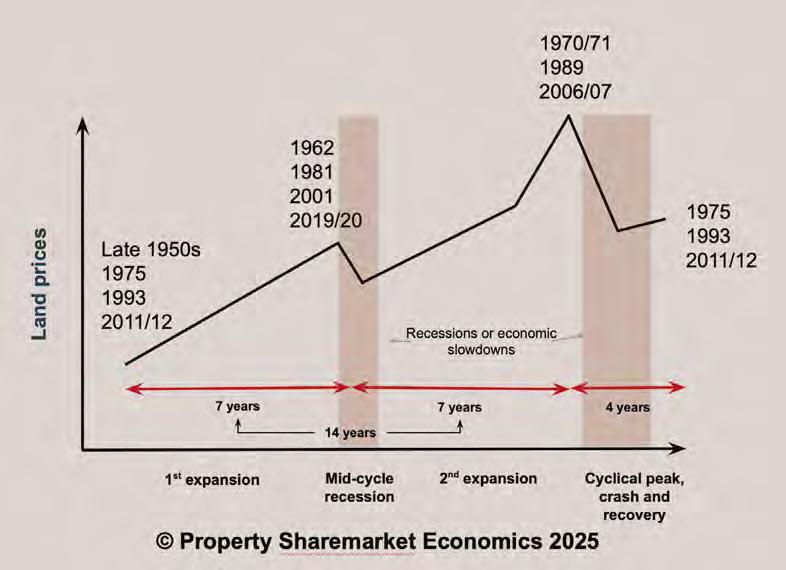
The hypothesis, supported by substantial evidence, is that there’s a fairly regular 18-year cycle – sometimes 16-17 years, sometimes 20 years, but pretty consistent. All major financial crises and recessions in the past 200 years in Western economies, particularly the US and UK, show this pattern of boom and bust, always resulting in a major financial crisis at the end, followed by relatively lengthy periods of increasing activity, wealth, and prosperity.
The world is cyclical. […] You see periods of rising prosperity and activity, then suddenly periods of falling prosperity and crises.
I should clarify that I’m not the discoverer of this cycle – my work makes it practical for business and investment decisions. The foundation comes from American economist Homer Hoyt, who in the 1930s analysed land sales data in Chicago over the 19th century. He discovered an 18-year pattern of boom and bust in property values and identified five complete cycles as Chicago grew from villages to a major metropolis.
We use land prices and land sales as fundamental data. In the modern economy, we track house prices. I also use money supply data, since banking system activity strongly influences property markets. The bond market and yield curve provide good warning signals about recessions. Stock market data, particularly homebuilders, is useful because the market is a price discounting mechanism, typically three to six months ahead of events.
Most Western countries are now synchronised to the cycle. In the 19th century, the UK and the US exhibited the 18-year pattern but were opposite each other. After World War II, all countries reset at the same point due to reconstruction in the late 1940s and early 1950s. They all experienced a major crisis in 2008.
Interestingly, in countries that had been really beaten back, such as Japan, they had a major boom in the 1950s and 1960s. Japan actually had a relatively minor crisis in the 1970s when we had a major crisis in Western economies. But very famously, 18 years after that, Japan had a really significant crisis in the early 1990s.
The real question as we go forward now is the extent to which China also exhibits the same pattern. The Chinese economy is a bit different. It has capitalistic characteristics, but also very heavy state intervention. But the signs are that in the Chinese market, property plays a central role. There’s a lot of leverage against that property.
We use land prices and land sales as fundamental data […] Land is essentially a scarce asset that doesn’t get created – it’s a gift of nature. Therefore, whoever owns land has monopoly pricing power.
Any economic activity requires land because it must take place somewhere. Land is essentially a scarce asset that doesn’t get created – it’s a gift of nature. Therefore, whoever owns land has monopoly pricing power. While there’s competition in labour and capital markets that reduces surplus, the residual value flows to land. Even if you own your business property, the extent to which you’re making profits tends to get funnelled into the land market.
This makes land attractive for speculation, buying land, holding it, and selling it for a higher price tomorrow. It also underpins collateral in the banking system. Banks can push credit into the property market, enabling people to pay more for land. But when it comes down to it, it affects what the banking system can do. So it has a dual role in both boom and bust.
Construction activity and house prices are obvious indicators. Land is very locational, and towards the cycle’s end, the most speculation occurs in relatively small towns or at city edges. Money supply is crucial – if banks are pumping money into the economy, it’s largely going into property markets.
I also use the stock market. If homebuilding stocks decline while the broader market rises, it suggests analysts are forecasting lower future earnings, indicating a slowdown coming in the property market and potentially the broader economy.
It’s an 18-year cycle – sometimes the first seven years are shorter or longer, and the second seven years vary, but the final crisis recovery phase is fairly regularly around four years.
The cycle begins when you’re really feeling difficulties from the last crisis. The banking system is on its knees, banks aren’t lending, sentiment is negative, house prices are down, and the stock market has dropped typically 50%. But that’s when the crisis ends and the new cycle starts.
The previous cycle peaked around 2007, and the current one started in 2011 or early 2012. Remember, in the UK, we were talking about a triple-dip recession. Mario Draghi said, ‘I’ll do whatever it takes to save the euro.’ Big statements like this often mark the cycle’s turning.
Activity begins, often in new industries related to new technology. I’d particularly point to everyone having 4G smartphones by the early 2010s, which birthed numerous industries affecting banking, dating, transportation, and accommodation. This drove investment in Silicon Valley and London. By 2012-2013, construction cranes appeared, and property markets burst in 2013.
You’d expect about seven years of upward movement, so around 2019, you should have shown slowdown signs. We did get that, though people weren’t paying attention. The world was slowing into COVID, which effectively ended the mid-cycle recession. Then we introduced an enormous stimulus that started the second half.
What might have taken four or five years happened between mid-2020 and early 2022. Property prices went bananas. Central banks panicked in 2022 about inflation and took rates from zero to north of 5% very quickly, which has somewhat killed what might have been a longer boom.
Nonetheless, we’re getting close to the current cycle’s peak. You’d expect the next four years to involve a fairly significant downturn, if not a financial crisis.
No two cycles repeat exactly. The US was at the centre of the 2008 crisis, so it’s likely the epicentre might be elsewhere this time. Areas going crazy with construction and speculation – the Middle East, parts of Asia, Japan, and Germany – are candidates. You look for countries with the most rapid property price increases, construction, optimism, and excessive behaviour.
COVID was incredibly disruptive. The money pumped directly into people’s bank accounts was unprecedented. When people emerged with record savings, they went for it – at a time when businesses had shut down and supply chains were restricted. Sellers had greater pricing power, demand was price-insensitive, and we had an inflation burst.
That behaviour you’d normally expect toward the end of the second half. The final two years before the peak usually have the greatest mania. This cycle’s variation is that we got the most excessive behaviour early. However, given the share prices of companies like Nvidia and what’s happening in AI, we’re seeing manic behaviour right on time. So it’s not that all of the excessive behaviour has occurred in the first couple of years, but the AI investment mania is the variation for this cycle.
Yes. Looking at prices people pay relative to current or prospective earnings, I can only call it a bubble. There’s enormous hype. The business case for some AI companies isn’t as strong as it should be. If you’re spending hundreds of billions on training models, you’d want a greater guarantee of proper returns.
Pricing and fundamentals have taken different paths – a classic bubble indication. The interrelationships between main AI players are concerning: Nvidia investing in OpenAI, circular contracts, Nvidia’s exposure to large customers in Taiwan (significant geopolitical risk), and Nvidia’s share price significance to the overall US market. There’s enormous interconnection. When one thing falls, it could have a significant domino effect.
Many people know about this, so some concern might be priced in. But historically, it’s the things people haven’t thought about that trigger crises. People weren’t talking about subprime mortgages in early 2007. Maybe data centres, which require land and bank credit, face regulation that squeezes activity, brings prices down, causes bank failures, reduces lending, creating a cascading effect.
No two cycles repeat exactly. The US was at the centre of the 2008 crisis, so it’s likely the epicentre might be elsewhere this time.
Parts of the US have an enormous investment there. But look at Dubai and Saudi Arabia – building skyscrapers, artificial islands, ski resorts in deserts. That’s malinvestment.
The UK has spent the last 10 years arguing about Brexit and hasn’t really had a very crazy speculative boom like we had in the 2000s. So I don’t think it would trigger the crisis, but it would be affected by it, of course. Ireland and Spain, affected by the Euro crisis last time, have had significant property booms. A left-field suggestion would be somewhere like Germany. The German government was quite pleased at how it handled the last crisis because it hadn’t had much of a property boom and didn’t need to bail out the banks in the same way that the US government and British government did. Maybe people there are less aware of the consequences of some of these things related to the property market. But on the other hand, things are quite flat in Germany, as I understand, given the effects of decline in manufacturing and the Ukraine war.
Triggers are usually where there’s been the most rampant speculation.
I’d say the Middle East is probably more likely.
The dot-com bubble occurred midcycle, about seven years in. The US had a six-month recession in 2001 with no banking system effect. The AI bubble is more related to the cycle’s end and decline in land prices. AI is a huge global investor linked to banks and credit providers. So there are some parallels. Both involved enormous capital investment and overinvestment in infrastructure capacity. They certainly have those two things in common.
Another interesting parallel is Japan in the 1980s – industrial conglomerates with preferred banking partners in incestuous groupings. Banks lending to companies like Mitsubishi to buy and speculate in land would boost Mitsubishi’s share price, which would boost the bank’s share price because it owned shares in Mitsubishi. I see parallels to the current AI space.
Another parallel is the railway booms of the 19th century –enormous capital investment in lines that could never make returns, yet there was hype and speculation driving share prices up. Ultimately, hot air underneath the claims.
For the last 10 years, we’ve highlighted 2026 as the likely peak – when you don’t get much more residential property market appreciation. You’d then expect six to twelve months later to be at the start of a significant financial crisis. The residential property peak was probably 2007, maybe late 2006 in the US. The financial crisis didn’t really hit until late 2007 and built up in 2008.
We’re arriving at the peak now, might get there sometime this year, and you’d expect not long before a major crisis – maybe 2027.
There can sometimes be longer lags. In the 1920s, the US residential peak was 1926, but the commercial market boomed in 1927-1928. Manhattan skyscrapers were built well
over demand assessment – building for building’s sake, with no genuine tenants. Then a really significant crash in 1929-1931.
I don’t think we’re in the same era as the 1920s. The base case is peak this year, then looking for a major crisis within a year after that.
The top of the property market, the land market. Residential prices stop going up. They may not go down initially – might go sideways. There’s an argument we’re starting that period now. I think we’ll get a bit more before the peak. Data is often lagging by two or three months.
The stock market tends to peak after real estate. Sometimes it’s quick to price in crisis problems, sometimes it’s longer. If something significant happened – trade war ending, Fed reducing rates to 2%, Ukraine war ending, US-China trade war stopping – it may artificially stimulate things longer. You’re living on borrowed time at this cycle point.
Against a worsening economic backdrop, we might see a very volatile stock market – big down moves, then the government pumping money in. Trump sets store by stock market performance, so the government might intervene. It could be a series of big moves up and down, like the
late 1970s and early 1980s. By the early 1980s, investors had had enough – Businessweek ran “The Death of Equities” in August 1982, which was pretty much the best time to buy stocks in 20 years.
It’s not a one-time event. Even in 2007-2008, there was nearly a year between Bear Stearns and Lehman Brothers collapsing.
There’s a peaking land market as a backdrop. Real estate stops rising. Delinquencies increase. Then something monumental, like an AI bubble crash, occurs.
This has a dual effect. First, interconnected companies and financing providers collapse. Second, a symbolic effect – something major crashed, so people examine all investments and pull back. This cascades to other sectors. Banks lend less, and businesses fail. It’s like dominoes.
The first sign of the problem in the last cycle was in February 2007, when HSBC reported losses on some of its funds. That led to a bit of a sell-off in the US market – it soon recovered, but the bond market started to price in problems. Then there was a period of calm. The stock market got back up. There were problems in the summer: everyone might recall the run on Northern Rock, which had been borrowing very short-term money to lend to people buying property. That couldn’t be sustained because interest rates were moving up, at least in the rate of interest that banks lend to each other. Then people got worried about the cash that was in the bank, and the first run on a British bank in 150 years happened.
Then that went away, and markets got up to new highs. But clearly underneath, there were a lot of problems. In March, Bear Stearns collapsed when it was unclear to what extent central banks were backstopping the system. Then there was the series of rolling crises during 2008 and 2009.
Default, maybe not, but bond market problems – the rate they pay on borrowings – likely, given debt levels, lack of confidence, and concerns about the dollar’s future role.
We saw a taste in September 2022 when Liz Truss spooked bond markets with spending plans. The Bank of England dealt with it, but it created a rate spike we’ve never really recovered from.
The US might experience something similar, partly because people aren’t rushing into dollars like before. Central banks are buying gold, diversifying reserves. BRICS countries are looking to create financial systems less dollar-based, maybe commodity-based or with bigger roles for Chinese currency or currency baskets.
The crisis will play out differently from last time. Western countries might have less of a safe haven role because they’re indebted, and there are alternatives. This will create significant panic if default looks possible. Countries can’t actually default unless they’ve borrowed in currencies that are not their own. If it’s their own currency,
they can print as much as needed. There are consequences, but no technical default.
I’ve had that thought for some time, but have been surprised by Bitcoin’s price action recently. Gold has surged toward $4,500, silver above $50 for the first time, but Bitcoin’s been strange – moving up and down. It’s early to conclude either way, but I’m not sure the thesis is as sound as I thought earlier this year.
When you get to a cycle’s end, people must park money somewhere. Above certain levels, you can’t keep it in banks. Deposit insurance might not work. Some big tech companies sitting on enormous cash might see inflows. Maybe the US dollar and government for being tried and trusted at a size people can use. Also, the gold market. Bitcoin might be one of those markets. You’d have to look at different property types or stock market parts. Maybe Nvidia increases in value because of that.
We’re coming out of a cycle with international financial arrangements quite different from when we started. Know how the cycle has played out in the past, have your eyes open, and be prepared for something different.
Yes, but they are more likely in countries that can’t access their currency and need ways to bail out institutions. I’m looking particularly at Eurozone countries where acquiring euros in a crisis depends on Brussels’ decisions.
It’s not universally going to happen. Many governments have given themselves the option, but I’d be surprised if it’s widespread. They’ll use crises to advance policies like digital currencies or widespread stablecoin use in the US, changing bailout and stimulus dynamics.
We’ve had a taste – the UK’s Eat Out to Help Out during COVID gave money on a time-limited basis for hospitality. You could do this more widespread, directly stimulating negatively affected parts of the economy. The problem is it gets caught up in politics.
Inflation will drop in a crisis unless there’s enormous stimulus in areas generating inflation. Otherwise, expect disinflation and deflation when interest rates drop.
The comfort is that tech stocks tend to move upwards first in recovery phases, symbolic of capital and investment in ideas flowing through tech. If you’re in that space, it can be an exciting time with many opportunities. Recovery takes place there first.
We’re scratching the surface of these technologies’ potential. While we’re in a bubble with overinvestment in AI, fundamentally, the technology is game-changing with the right applications. Similarly, many crypto coins are rubbish, but the technology is game-changing for revolutionising payments and contracting. It’s going to fundamentally reshape the economy.
Productivity gains in the next 1020 years will be enormous and give me optimism for the next cycle. The key is surviving the downturn. If you can do that with the ability to invest or make decisions out of opportunity rather than necessity, you can be in a really good position for the next cycle’s beginning – the best time to invest and expand.
It depends on circumstances, but generically: first, if you’re invested in crypto and stock markets, ensure you’re not over-leveraged. Don’t commit more money. Build reserves. Don’t buy based on capital gain just because it rose 20% last week. Stick to fundamental values.
Second, we’re potentially at a time of difficult conditions. Assess your businesses, investments, and borrowings. Under different scenarios – revenue declining X percent – can you survive? Can you reduce costs? Continue servicing debt? Ensure that for a few years you won’t be forced to sell something you don’t want to. You definitely don’t want selling during a crisis – you won’t get good prices and you’ll be forced to sell your best stuff.
Cash tends to be scarce in these organisations, so build that up. If you have borrowings, manage them and handle not being able to roll over debt during a crisis. Banks having problems won’t lend on speculative business opportunities.
The majority of expenses are staff expenses. Knowing how to handle that cost base during a downturn is very important – reducing hours or headcount. As unfortunate as it may be, the goal is survival.
But also look around. If you’re surviving with reserves, look at businesses you might partner with or acquire as things recover. It’s both retrenching and being willing to expand, having survived.
The Secret Wealth Advantage: How You Can Profit from the Economy’s Hidden Cycle is structured as a journey through the cycle. I take readers through each stage using different historical episodes, outlining how each stage plays out, what to look for, and investment decision ideas.
I explain why the cycle happens – the role of land capturing gains of progress and development. I explain why people don’t see the cycle, how money and banking fit in, why investment managers don’t understand how to navigate it, and how to stay safe, avoiding fraudulent activity that tends to emerge at cycle peaks. It’s both explanatory and predictive, giving people a clear idea of how the cycle plays out and how to take advantage of it.
Visit propertysharemarketeconomics.com and sign up for our free newsletter. There’s also access to archive material, so you can see what we wrote and said on podcasts in the past, some of the market calls we’ve made.
